How LBH Yogyakarta Empowers Communities on the Frontlines of Climate Justice — Part 1: Stories from Kampung Laut
Climate JusticeOctober 4, 2026
Nico Novito
This is Part 1 of a two-part series on the advocacy of LBH Yogyakarta (Yogyakarta Legal Aid) that intersects with the issue of climate justice. The residents of Kampung Laut—a coastal community in Cilacap, Central Java—face the dual challenges of environmental change and land insecurity. With support from Pundi Asa, LBH Yogyakarta works alongside them to strengthen legal awareness and community power as they defend their rights and livelihoods.
See Part 2 here.
For generations, the community of Kampung Laut relied on local wisdom to guide their farming activities. The residents of the district—made up of several villages in the coastal Cilacap region of Central Java—used to consult the traditional Javanese calendar and planting systems as guided by the stars. “But those long-standing weather patterns no longer hold true. It has become increasingly difficult to know when to cultivate their land,” shared Julian Duwi Prasetia. As a result, some farmers faced crop failure and could not make their ends meet. For example, back in 2024, the residents of Klaces village in Kampung Laut experienced crop failure due to an unexpected tidal flooding.
As the director of LBH Yogyakarta (Yogyakarta Legal Aid) from 2022 to 2026, Julian realized that the reality of climate change hit these local communities the hardest. “I came to understand that the impacts were not some abstract concepts. They are a lived-in reality for farmers in Kampung Laut and other regions,” he said in an interview with Pundi Asa.
Kampung Laut is only one of the communities across Yogyakarta and Central Java provinces that receive legal support from LBH Yogyakarta. Apart from facing the harsh reality of global warming, some of these communities also face land dispute cases against government authorities or private developers, adding another layer of frustration to their livelihoods—you will learn more about their stories below.
Climate change has become a strategic issue for the organization. “We saw how many forms of injustice today are linked to the climate crisis,” Julian said about his tenure as director. “We have witnessed government policies that fail to prioritize environmental protection, with the consequences borne by both ecosystems and the communities whose livelihoods and living spaces depend on them.”

Fighting for the Rights of Justice Seekers
“A primary focus for LBH Yogyakarta is to break the shackles of injustice, specifically the injustice perpetuated through structural impoverishment arising from systems that structurally drive poverty,” Julian explained
Established in 1981, the legal aid organization operates as part of Yayasan Lembaga Bantuan Hukum Indonesia (YLBHI), or Indonesian Legal Aid Foundation. The organization provides legal assistance and consultation for what Julian dubbed the “justice seekers,” especially those facing structural injustice and inequality, where multiple dimensions—from socio-political to development and climate dimensions—play a role.
“Our advocacy and legal assistance become the entry point to fight against such injustice. Therefore, we prioritize cases that widely affect the public because we’re targeting the system,” he added, referring to Kampung Laut as an example.
Despite its name, LBH Yogyakarta’s mandate goes beyond the Special Region of Yogyakarta and also includes around 15 regencies in the southern part of Central Java—encompassing a total population of 19.7 million people.
Although they have to cover such a large geographical area, LBH Yogyakarta currently only employs a staff of around 30 people. They are also supported by a network of around 70 paralegals who are distributed throughout the operational regions and act not only as the middlemen between the public and LBH Yogyakarta, but also as the frontliners with whom members of the public can discuss and consult about the legal issues they are facing.
Despite its important work, availability of resources and lack of access usually hinder the organization from carrying out their work—which is why the prioritization of strategic cases is important. “We also network with other legal aid organizations and recommend the paralegals that we have trained. So at least, the justice seekers in each community can discuss and consult with their local paralegal first as the initial filter,” Julian explained.
To address the limited resources of LBH Yogyakarta, Pundi Asa has provided targeted support to cover the organization’s critical operational needs so that it could deploy legal assistance for urgent, high-priority cases.

Bringing Access to Justice in Kampung Laut
Kampung Laut is a coastal area in Cilacap, Central Java, that has undergone ecological changes due to sedimentation in the Segara Anakan lagoon. Over time, the accumulation of sediment created the so-called tanah timbul (accreted land), which local communities cultivated as farmland after declining fish stocks and changing environmental conditions affected their traditional livelihoods. These lands have become an essential source of income and part of the living space for many residents.
The residents of the villages there—including Ujungalang, Klaces, and Gragalan—also now face an ongoing agrarian dispute over approximately 34.2 hectares of this accreted land with the government authority of the high-security Nusakambangan Penitentiary (Lembaga Pemasyarakatan Nusakambangan) in the area. The government sought to use the surrounding land for institutional sterilization measures and a state-backed food estate as well as vocational training projects.
“In early 2025, we started to help the residents there defend the land they’ve been inhabiting for many years, when they started facing attempts of eviction by the Nusakambangan Penitentiary authority,” said Wandi Syahputra Nasution, LBH Yogyakarta’s head of economic, social, and cultural advocacy division, in an interview. He explained that this land dispute was also caused by other collaborating actors, including investors with an interest in the food estate project with three planned clusters: agriculture, livestock farming, and aquaculture.
“The residents have been living in Kampung Laut for more than 30 years, but they are treated as ‘nobodies’ by the authority,” explained Kharisma Wardhatul Khusniah, the current director of LBH Yogyakarta for the period of 2026–2030. “When an empty land has been occupied and cultivated by the community, that actually can be considered as a form of ownership under the Basic Agrarian Law [Undang-Undang Pokok Agraria].”
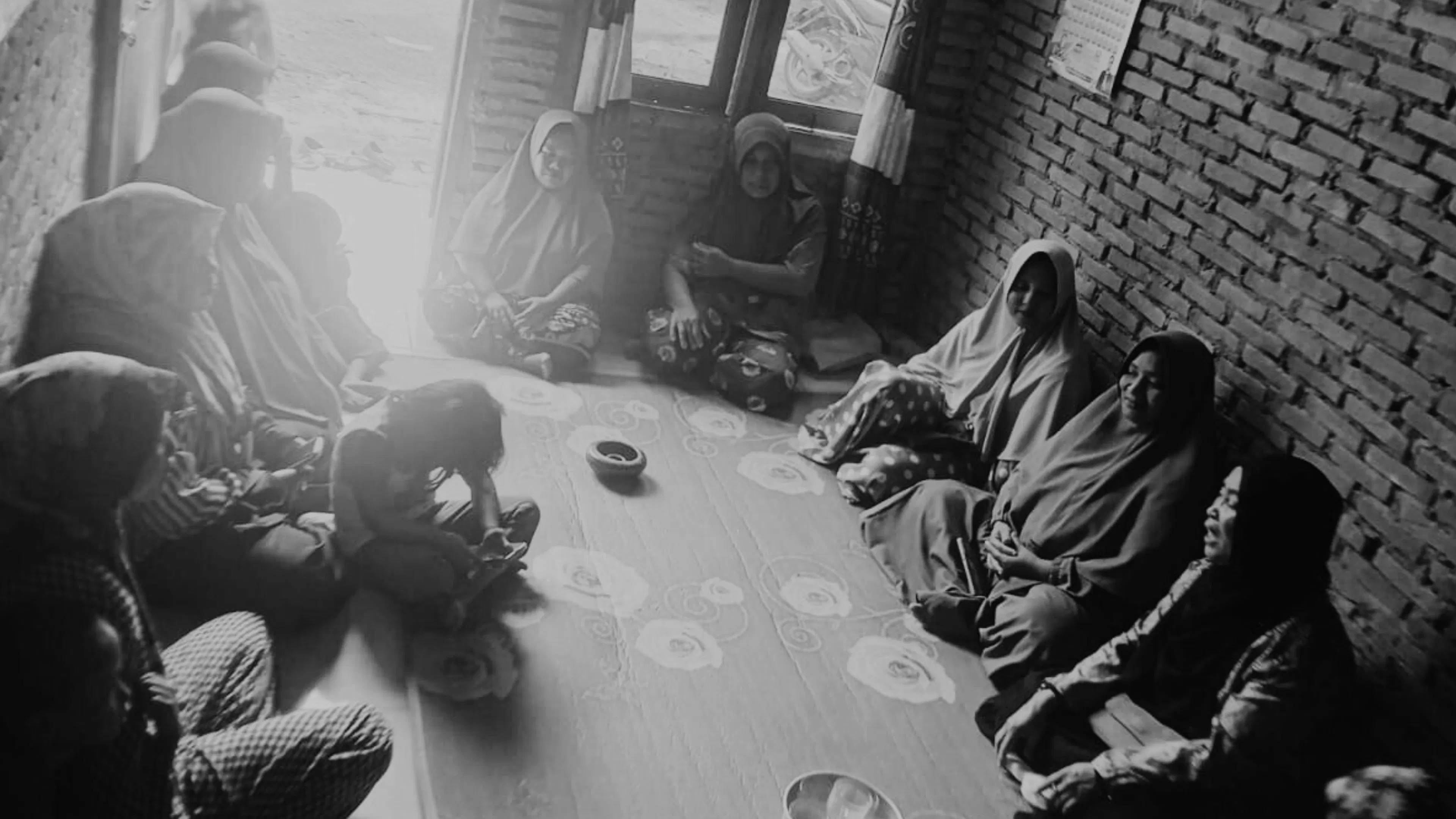
To fight against the land dispute, community members sought LBH Yogyakarta’s help to organize themselves. “In 2025, an association called BATA LAUT (which stands for Kampung Laut’s Association of Farmers and Fishermen) was founded. This becomes the advocacy vehicle for residents to coordinate protests and support each other,” Wandi said.
Some residents participated in critical legal education sessions (or PHK, which stands for pendidikan hukum kritis) to understand their basic legal rights in the case. “We also provided lessons on how to create their own campaign on social media, so they can report the situation on the land directly through their media,“ Kharisma added.
Despite the challenge of transportation access (it takes 5 hours for LBH Yogyakarta team to travel by car to Kampung Laut’s nearest harbor before spending another hour or two to travel by boat), the advocacy team is committed to visiting the area almost every week. “Even the villages here are separated by water. It can take up to 2 hours to travel between Gragalan and Klaces, for example,” explained Wandi. “Therefore, when we started PHK, we would assign coordinators to disseminate the knowledge to the other residents in their respective villages.”
Until now, the residents persevere and still manage to stay on the land that they’ve been inhabiting and cultivating for decades, despite some alleged pressures from unidentified parties. “Some residents reported to us that they had received threatening messages via text or even got their mobile phones hacked,” said Wandi.
In spite of these challenges, thanks to the critical legal education sessions that they have participated in, “the residents are now able to advocate for their own rights and argue for themselves,” Wandi said, citing their efforts to organize protests against the local authorities.
With support from Pundi Asa to ease the burdens of LBH Yogyakarta’s day-to-day operations in this case, the organization’s team members could provide non-litigation assistance such as training and workshops to around 60 members of the Kampung Laut community so that they can help defend their land rights.
“The community members also held audience hearings with the regional government authority. They also know how to make simple documentation with their phones if any violation happens on their land,” explained Astutik from the finance division of LBH Yogyakarta who worked closely with Pundi Asa.
Asked about what he thought was the biggest achievement in this case so far, Wandi said that the most important thing was that “at least the people there have already developed their critical point of view about their legal rights.”
He added: “We never made a promise whether they would win this case or not eventually, but as long as they are empowered to keep fighting for their rights and organizing themselves, I think that’s already a small win for us.”

Equipping the Communities to Defend Their Rights
Beyond questions of land ownership, the case highlights broader climate justice concerns about the threat of displacement of communities from their living space. In Kampung Laut, communities that have adapted to shifting ecological conditions now face uncertainty over the very land that sustains them.
For LBH Yogyakarta, the case demonstrates that climate justice is not only about protecting ecosystems. It is also about ensuring that communities have access to information, legal protection, and the ability to participate in decisions that affect their future. Through legal education and community organizing, residents of Kampung Laut have become more prepared to defend their rights and advocate for themselves.
Yet Kampung Laut is not the only place where these concerns emerge. Across Yogyakarta, other communities face different forms of pressure driven by development, environmental vulnerability, and unequal power relations. One such struggle is unfolding in Pantai Sanglen, Gunungkidul, where residents are fighting to protect both their livelihoods and the fragile coastal ecosystem they depend on.
Read more about LBH Yogyakarta’s advocacy in Pantai Sanglen in Part 2.
See Part 2 here.
For generations, the community of Kampung Laut relied on local wisdom to guide their farming activities. The residents of the district—made up of several villages in the coastal Cilacap region of Central Java—used to consult the traditional Javanese calendar and planting systems as guided by the stars. “But those long-standing weather patterns no longer hold true. It has become increasingly difficult to know when to cultivate their land,” shared Julian Duwi Prasetia. As a result, some farmers faced crop failure and could not make their ends meet. For example, back in 2024, the residents of Klaces village in Kampung Laut experienced crop failure due to an unexpected tidal flooding.
As the director of LBH Yogyakarta (Yogyakarta Legal Aid) from 2022 to 2026, Julian realized that the reality of climate change hit these local communities the hardest. “I came to understand that the impacts were not some abstract concepts. They are a lived-in reality for farmers in Kampung Laut and other regions,” he said in an interview with Pundi Asa.
Kampung Laut is only one of the communities across Yogyakarta and Central Java provinces that receive legal support from LBH Yogyakarta. Apart from facing the harsh reality of global warming, some of these communities also face land dispute cases against government authorities or private developers, adding another layer of frustration to their livelihoods—you will learn more about their stories below.
Climate change has become a strategic issue for the organization. “We saw how many forms of injustice today are linked to the climate crisis,” Julian said about his tenure as director. “We have witnessed government policies that fail to prioritize environmental protection, with the consequences borne by both ecosystems and the communities whose livelihoods and living spaces depend on them.”
Fighting for the Rights of Justice Seekers
“A primary focus for LBH Yogyakarta is to break the shackles of injustice, specifically the injustice perpetuated through structural impoverishment arising from systems that structurally drive poverty,” Julian explained
Established in 1981, the legal aid organization operates as part of Yayasan Lembaga Bantuan Hukum Indonesia (YLBHI), or Indonesian Legal Aid Foundation. The organization provides legal assistance and consultation for what Julian dubbed the “justice seekers,” especially those facing structural injustice and inequality, where multiple dimensions—from socio-political to development and climate dimensions—play a role.
“Our advocacy and legal assistance become the entry point to fight against such injustice. Therefore, we prioritize cases that widely affect the public because we’re targeting the system,” he added, referring to Kampung Laut as an example.
Despite its name, LBH Yogyakarta’s mandate goes beyond the Special Region of Yogyakarta and also includes around 15 regencies in the southern part of Central Java—encompassing a total population of 19.7 million people.
Although they have to cover such a large geographical area, LBH Yogyakarta currently only employs a staff of around 30 people. They are also supported by a network of around 70 paralegals who are distributed throughout the operational regions and act not only as the middlemen between the public and LBH Yogyakarta, but also as the frontliners with whom members of the public can discuss and consult about the legal issues they are facing.
Despite its important work, availability of resources and lack of access usually hinder the organization from carrying out their work—which is why the prioritization of strategic cases is important. “We also network with other legal aid organizations and recommend the paralegals that we have trained. So at least, the justice seekers in each community can discuss and consult with their local paralegal first as the initial filter,” Julian explained.
To address the limited resources of LBH Yogyakarta, Pundi Asa has provided targeted support to cover the organization’s critical operational needs so that it could deploy legal assistance for urgent, high-priority cases.
Bringing Access to Justice in Kampung Laut
Kampung Laut is a coastal area in Cilacap, Central Java, that has undergone ecological changes due to sedimentation in the Segara Anakan lagoon. Over time, the accumulation of sediment created the so-called tanah timbul (accreted land), which local communities cultivated as farmland after declining fish stocks and changing environmental conditions affected their traditional livelihoods. These lands have become an essential source of income and part of the living space for many residents.
The residents of the villages there—including Ujungalang, Klaces, and Gragalan—also now face an ongoing agrarian dispute over approximately 34.2 hectares of this accreted land with the government authority of the high-security Nusakambangan Penitentiary (Lembaga Pemasyarakatan Nusakambangan) in the area. The government sought to use the surrounding land for institutional sterilization measures and a state-backed food estate as well as vocational training projects.
“In early 2025, we started to help the residents there defend the land they’ve been inhabiting for many years, when they started facing attempts of eviction by the Nusakambangan Penitentiary authority,” said Wandi Syahputra Nasution, LBH Yogyakarta’s head of economic, social, and cultural advocacy division, in an interview. He explained that this land dispute was also caused by other collaborating actors, including investors with an interest in the food estate project with three planned clusters: agriculture, livestock farming, and aquaculture.
“The residents have been living in Kampung Laut for more than 30 years, but they are treated as ‘nobodies’ by the authority,” explained Kharisma Wardhatul Khusniah, the current director of LBH Yogyakarta for the period of 2026–2030. “When an empty land has been occupied and cultivated by the community, that actually can be considered as a form of ownership under the Basic Agrarian Law [Undang-Undang Pokok Agraria].”
To fight against the land dispute, community members sought LBH Yogyakarta’s help to organize themselves. “In 2025, an association called BATA LAUT (which stands for Kampung Laut’s Association of Farmers and Fishermen) was founded. This becomes the advocacy vehicle for residents to coordinate protests and support each other,” Wandi said.
Some residents participated in critical legal education sessions (or PHK, which stands for pendidikan hukum kritis) to understand their basic legal rights in the case. “We also provided lessons on how to create their own campaign on social media, so they can report the situation on the land directly through their media,“ Kharisma added.
Despite the challenge of transportation access (it takes 5 hours for LBH Yogyakarta team to travel by car to Kampung Laut’s nearest harbor before spending another hour or two to travel by boat), the advocacy team is committed to visiting the area almost every week. “Even the villages here are separated by water. It can take up to 2 hours to travel between Gragalan and Klaces, for example,” explained Wandi. “Therefore, when we started PHK, we would assign coordinators to disseminate the knowledge to the other residents in their respective villages.”
Until now, the residents persevere and still manage to stay on the land that they’ve been inhabiting and cultivating for decades, despite some alleged pressures from unidentified parties. “Some residents reported to us that they had received threatening messages via text or even got their mobile phones hacked,” said Wandi.
In spite of these challenges, thanks to the critical legal education sessions that they have participated in, “the residents are now able to advocate for their own rights and argue for themselves,” Wandi said, citing their efforts to organize protests against the local authorities.
With support from Pundi Asa to ease the burdens of LBH Yogyakarta’s day-to-day operations in this case, the organization’s team members could provide non-litigation assistance such as training and workshops to around 60 members of the Kampung Laut community so that they can help defend their land rights.
“The community members also held audience hearings with the regional government authority. They also know how to make simple documentation with their phones if any violation happens on their land,” explained Astutik from the finance division of LBH Yogyakarta who worked closely with Pundi Asa.
Asked about what he thought was the biggest achievement in this case so far, Wandi said that the most important thing was that “at least the people there have already developed their critical point of view about their legal rights.”
He added: “We never made a promise whether they would win this case or not eventually, but as long as they are empowered to keep fighting for their rights and organizing themselves, I think that’s already a small win for us.”
Equipping the Communities to Defend Their Rights
Beyond questions of land ownership, the case highlights broader climate justice concerns about the threat of displacement of communities from their living space. In Kampung Laut, communities that have adapted to shifting ecological conditions now face uncertainty over the very land that sustains them.
For LBH Yogyakarta, the case demonstrates that climate justice is not only about protecting ecosystems. It is also about ensuring that communities have access to information, legal protection, and the ability to participate in decisions that affect their future. Through legal education and community organizing, residents of Kampung Laut have become more prepared to defend their rights and advocate for themselves.
Yet Kampung Laut is not the only place where these concerns emerge. Across Yogyakarta, other communities face different forms of pressure driven by development, environmental vulnerability, and unequal power relations. One such struggle is unfolding in Pantai Sanglen, Gunungkidul, where residents are fighting to protect both their livelihoods and the fragile coastal ecosystem they depend on.
Read more about LBH Yogyakarta’s advocacy in Pantai Sanglen in Part 2.